
Start a Screven County Former-Owner Timeline
The Clerk of Superior Court holds the recorded deeds, liens, and plats for Screven County. Those courthouse deed records form the backbone of any prior-owner search. The statewide GSCCCA Real Estate Index backs them up. The online index is a strong starting point. Its coverage does not reach every early year, though. Deeper work sends you to deed books, historical indexes, and archives. Supporting tax or newspaper material helps as well.
| Source | Years It Covers | Where Held | What It Shows |
|---|---|---|---|
| GSCCCA Real Estate Index | Online cutoff not verified | Statewide official portal | Indexed parties, instrument and recording references |
| County deed books and indexes | Earlier recorded eras | Clerk of Superior Court | Conveyances and the legal description carried through time |
| Georgia Archives loose plats | 1783-1909 collection span | Georgia Archives | Headright and bounty plats, including Screven material |
| Library and newspaper sources | Collection-specific | Screven County Library and Georgia Historic Newspapers | Surname, estate, sale, and place-name clues |
Start online with a recent transfer. Write down the book, page, instrument type, and full legal description. When the chain runs early or the trail goes cold, contact the Clerk at (912) 564-2614 or visit 216 Mims Road in Sylvania during its posted weekday hours. Ask specifically for the grantor and grantee index, not just a search by modern address.
Build the Screven County Deed Chain in Reverse
A good working timeline gives one row per transfer. Each row cites its source. The example illustrates the method only, using no real parcel or owner. That discipline keeps a researcher from leaping from a current name to an unrelated older one.
| Transfer date | Grantor to grantee | Deed type | Book and page |
|---|---|---|---|
| Newest recorded transfer | Prior owner to current grantee | Copy the indexed type | Copy exact citation |
| Next earlier transfer | Earlier owner to prior owner | Verify from image | Copy exact citation |
| Earlier book era | Repeat matched parties | Read the instrument | Use county book/index |
Georgia's filing system holds warranty, quitclaim, gift, estate, trustee, and tax-sale deeds alike. The label by itself says little about title quality. Read the deed itself. Keep the described land tied firmly to the party names. The official GSCCCA Real Estate Index is the online starting screen for a recorded-party search.
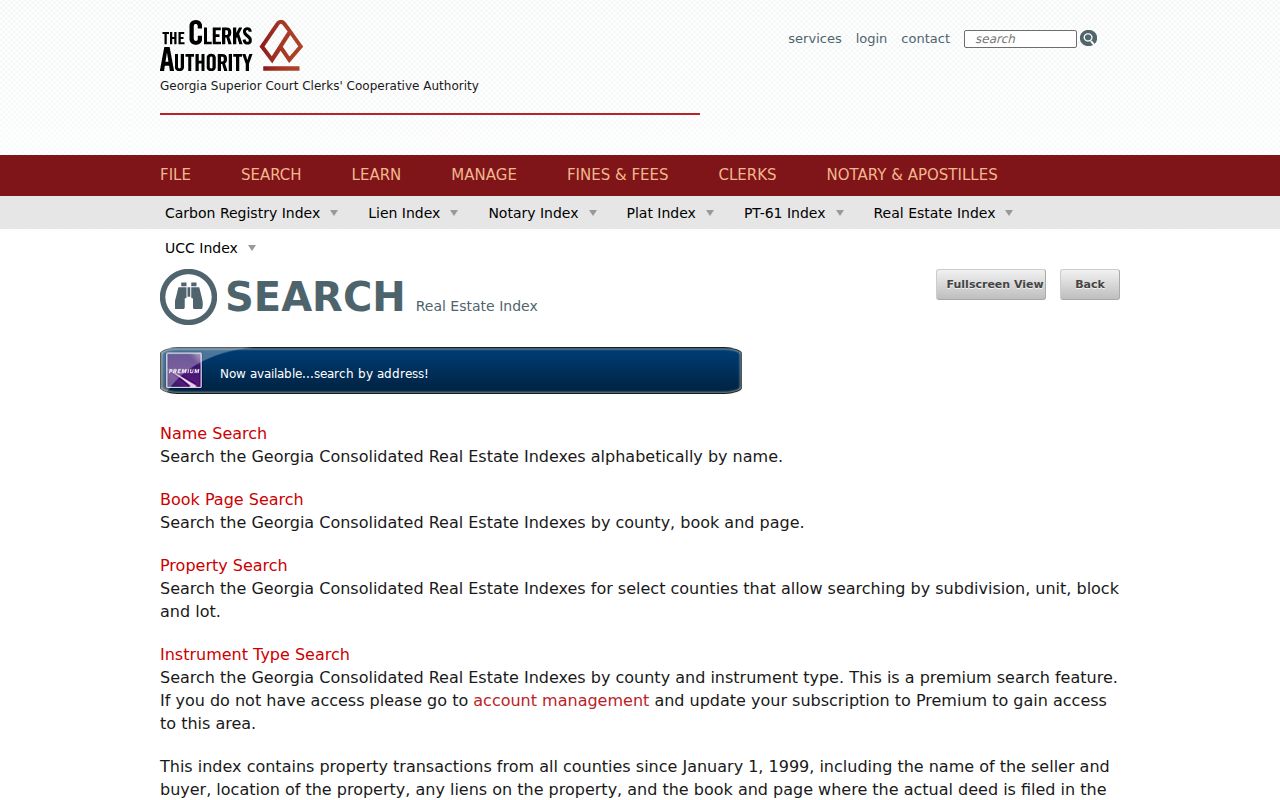
Use the county selector and index modes there to pull citations. Copy each one into your backward timeline.
The Online Cutoff for Screven County Previous Owners
The GSCCCA platform handles real-estate indexing, images, reports, and county selection. It publishes no firm start date for Screven County coverage. Treat a blank result as a route change. Never treat it as proof that no older conveyance exists. Real-estate staff contacts Lee H. Thompson or Aleicia M. Deal can point you to the right older index or deed book.
Coverage check. Ask the Clerk for the earliest searchable year and the correct older grantor-grantee book before concluding that the chain ends.
Why Screven County's Courthouse History Matters
Screven's records history rewards careful checking. Jacksonboro served as an early county seat, and Sylvania took that role in 1847. Union forces burned the courthouse in 1864. A second fire destroyed the Sylvania courthouse in 1896. Yet the Clerk's Office and county records reportedly survived. That survival means an old deed search should not end at the word fire. Frame the question with the Georgia Archives county-card index. Then ask the Clerk which exact deed book and index made it through. The Archives county cards work as an aid. But the recorded county volume stays the controlling local source.
Walk Screven County Prior Owners Backward
Begin with the newest deed that clearly describes the land. A current assessor card supplies a parcel key and an owner-of-record lead. The deed, though, gives the recorded grantor, grantee, and legal description needed for the next step back.
- Find the current owner's acquisition deed by searching that owner as grantee and confirming the parcel description.
- Copy the grantor's full indexed name, recording date, deed type, book/page, and every land identifier.
- Search that grantor as a grantee in an earlier period, then compare the acquired land with the later conveyance.
- Repeat until the online index ends, then continue through the Clerk's reverse indexes and deed books.
- Grantor / grantee
- The conveying party and the receiving party named in a deed.
- Chain of title
- The ordered sequence of recorded transfers affecting the same land.
- Reverse index
- An index used to find the instrument through a party's role and name.
- Quitclaim / warranty deed
- Different conveyance forms whose effect must be read from the document, not guessed from a search result.
Plats Keep Screven County Past Owners on the Same Land
An early deed may carry no street address. A modern parcel number can differ from its parent tract. Recorded plats fill that gap with lot, block, survey, easement, and right-of-way detail. Search the GSCCCA Plat Index by subdivision, surveyor, owner, or book and page. Then compare the plat against the deed's legal description.
Sylvania examples show why. One notice tied Sheppard Subdivision lots to four map parcels later combined into a 2.57-acre tract. It cited Plat Book 37, page 192. Another linked Screven Woods Phase I, Lot 17 to a 1994 survey. It cited Plat Book 28, page 123, plus two deed-book references. Treat these as leads only. The Clerk's recorded images control over newspaper text.
Reach Screven County's Earliest Land Trail
The Georgia Archives loose-plats collection spans 1783 through 1909 and includes Screven County material. FamilySearch catalogs Georgia wills, deeds, and probate records too, though index and image coverage varies. Both routes fill gaps when former owners predate modern parcel systems. An Archives presentation even reproduces a page from Screven Deed Book A. The page records an 1803 conveyance. It transferred 200 acres from Luke and Patience Mizell to John Minsey. That page is a vivid example of name-and-acreage research. It does not prove the full volume sits online. Carry every citation back to the county book or an Archives finding aid.
When an Estate Interrupts the Screven County Chain
An estate can make a chain look broken. Land often moved without a normal sale, passing through a will, an administrator, an executor, an heir, a gift, or a trustee instrument. The fix is patience. Run the same surname through the deed index, then turn to Screven Probate Court records or Georgia probate collections, where wills, inventories, administrations, guardianships, and estate minutes live. Probate papers can show who held authority to convey. Even so, the authority must still line up with the recorded property description before you treat the link as solid.
Local tools help with the murky stretches. The Screven County Library's C. Dixon Hollingsworth Jr. Genealogy/Georgia Room, with its local family-card collection, can tie a surname to real local context. Georgia Historic Newspapers adds notices and historic reporting. Neither source replaces a recorded deed. But both can untangle a spelling, family, or place-name clue that makes an old index usable again.
Know Where Screven County Ownership History Ends
Every parcel's paper trail ends somewhere different. Some lines stop at a burned book. Screven County deeds document private transfers, but an earlier headright, bounty plat, grant, or patent may rest in a state archive collection instead. A tax roll or a newspaper notice can corroborate who occupied or owned a parcel in a given year. Treat those as corroboration only. Without recorded support, an occupant should never be inserted into the chain as a deed transfer.
Lawful use. Former-owner research supports house history, estate work, and property diligence; never use personal information to target or harass anyone.
A rebuilt owner list is research, not a title opinion. Confirm any shaky link with the Clerk. When legal ownership or insurability is at stake, bring in a qualified title professional. For a single document's mechanics, the Screven County deed records guide walks through the official index. It also covers the copy routes.